

Frequently asked questions
-
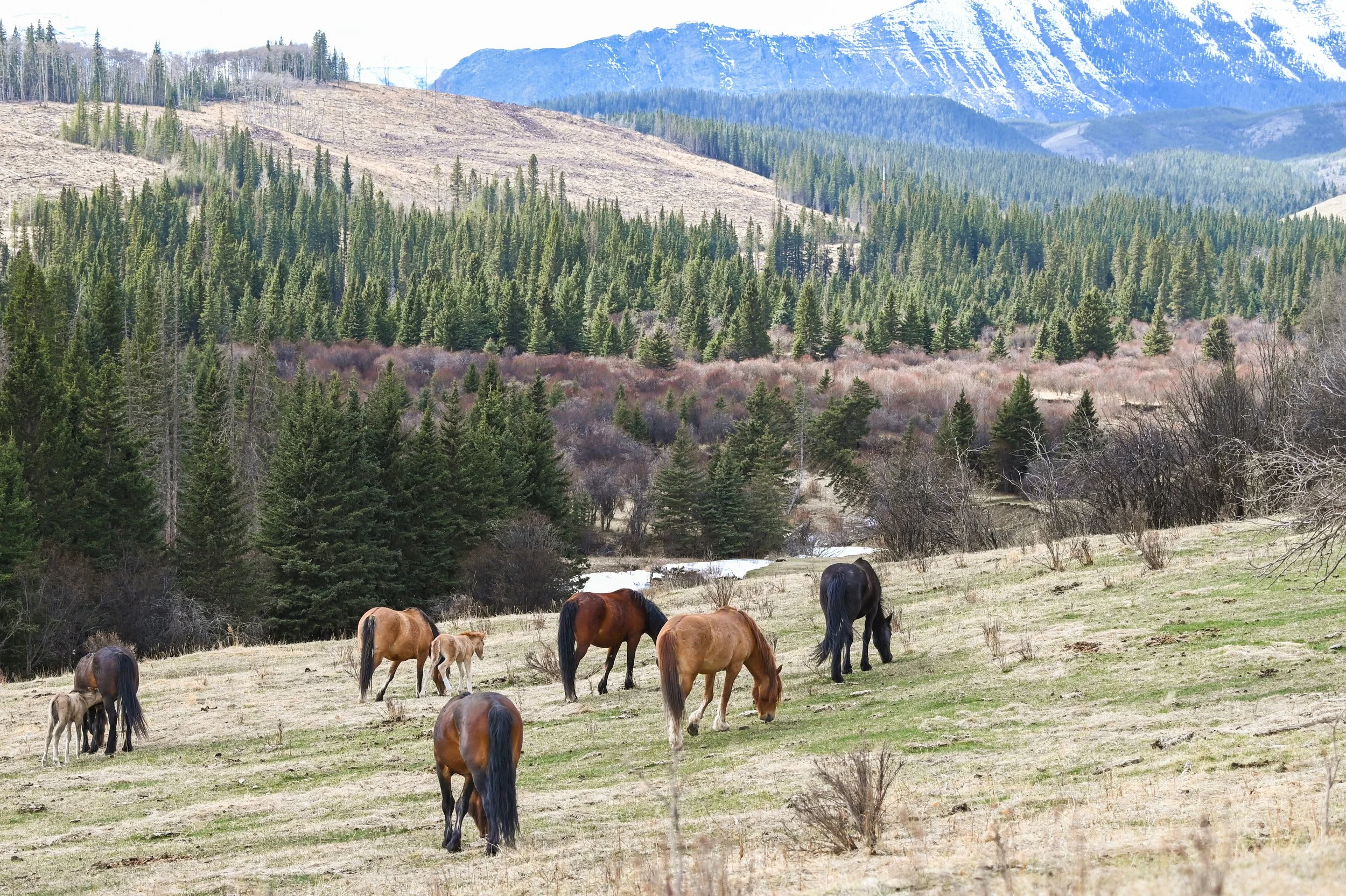
Alberta Mountain Horses are the province’s wild, free-roaming horses that live along the eastern foothills of Canada’s Rocky Mountains. They roam public lands, including forested areas, grasslands and clearings, where they find food, water and shelter.
The Alberta government officially refers to them as “feral horses”, while many members of the public refer to them as “wild horses”, “wildies”, or “free-roaming horses.” The term used matters because it can influence how people understand the horses and their place on the landscape.
-
Wild horse aerial population counts have been conducted annually since 2013 by the Alberta government, however, there has been little geographical consistency in the areas surveyed from year-to-year making the government’s population count data not statistically sound nor accurate.
Government of Alberta’s 2026 minimum horse survey reports a total of 2,072 free-roaming horses across all of the equine management zones (EMZs), encompassing approximately 2.2 million acres. The Sundre zone covers roughly 542,000 acres and had the highest population count of 1303 horses, while HAWS counted 1013 horses here.
Beginning in 2022, HAWS began conducting its own aerial counts in the most populous EMZ (Sundre) using flight paths identical to the government’s for comparative analysis. Some of these results and maps can be found under our website tab “Knowledge Hub/Horse Counts”.
With contradictory and highly fluctuating counts from year to year, Alberta’s Mountain Horse population still lies well below the population threshold of 2,500, used by the International Union for Conservation of Nature (IUCN) to identify elevated extinction risk when additional criteria such as a continuing population decline are present. Several factors have a direct impact on the stability of the population including Alberta’s seasonal climate, natural predation pressures, habitat pressures from shared land use and the province’s own policies involving management of the horses.
This represents risk of extirpation for Alberta’s wild horse population, a potential irreversible loss of a sub-species with deep historical and cultural significance. Additionally, the wildlife and ecological science community have documented many benefits that wild horses bring to their ecosystems and predict their disappearance would disrupt ecosystem dynamics, with negative cascading effects on biodiversity and land health.
-
Yes. Genetic research shows that Alberta Mountain Horses have a complex ancestry and possess distinctive genetic characteristics that distinguish them from other free-roaming horse populations.
Genetic analysis conducted by equine geneticist Dr. E. Gus Cothran in 2021, examining horses from Alberta's Sundre area, identified a strong Spanish Iberian ancestry, along with genetic contributions from other historical horse populations, including the Canadian Horse. These findings indicate that Alberta Mountain Horses have ancestry extending back several centuries, including horses introduced to the region through Indigenous trade and transportation networks in the 1600s.
This is significant because it challenges the assumption that Alberta's free-roaming horses are all descendants of relatively recent releases of domestic horses by ranchers, settlers and other land users. While it is well documented that domestic horses were released into the region over the years, the broader population's ancestry appears to reflect a much longer and more complex history of horses in western Canada.
Understanding and conserving this genetic heritage should be an important consideration in developing a long-term management and protection strategy for Alberta Mountain Horses.
-
Science has proven that horses evolved in North America around 55 million years ago, with Equus coming onto the scene around 4 - 4.5 million years ago. Throughout millennia, there was extensive migration back and forth across the Bering land bridge to Eurasia, today’s Europe, Asia and Africa. It is believed in the western science community that horses became extinct around the time of the last ice age – near the end of the Pleistocene epoch. In the 1400 - 1500s, horses were brought to North America by European explorers.
Because of this knowledge, many consider wild horses in North America to be non-native. However, some First Nations oral history disputes these claims with the belief they have always been here. In fact, more recent research is challenging the previously understood extinction timeline, with evidence that Equus survived much longer than originally thought, highlighting the need for further research in this area.
-
Alberta manages it’s free-roaming horses under a different legislative framework from the one used for wildlife species. Within its livestock framework, Alberta has a Horse Capture Regulation under its Stray Animals Act that governs aspects of horse capture and treatment, for all horses, whether they are free-roaming or domestic.
These provisions do not amount to a dedicated wild or free-roaming horse conservation law. HAWS advocates for a distinct legal status and specific protections for Alberta’s Mountain Horses.
-
The Alberta Mountain Horses occupy public lands shared with cattle, oil, gas and logging industries, wildlife and recreation. This creates zones of conflict primarily with industry stakeholders concerned with potential for overpopulation, forage competition among grazers and ecosystem degradation, despite the lack of evidence supporting any of these risks in the vast geographic zones the horses inhabit. Periodic government-sanctioned roundups and large scale culls have occurred to reduce the wild horse populations throughout the 20th and 21st centuries.
-
The Ministry of Forestry and Parks administers the 2023 Feral Horse Management Framework. This framework establishes population thresholds and management strategies intended to balance free-roaming horse populations with government objectives for rangeland health, wildlife habitat and other uses of public lands.
The province divides a vast Horse Management Area into six Equine Management Zones (EMZs), covering approximately 2.2 million acres. Aerial surveys are used to estimate minimum horse populations in each zone and assess them against established population thresholds.
The framework classifies each zone as Green (acceptable), Yellow (concerning) or Red (unacceptable), depending on horse numbers relative to established thresholds. Management activities may include population monitoring, fertility control (contraception), adoption programs and licensed capture and removal of horses. In Red zones, more active intervention is undertaken, with sale or adoption prioritized and euthanasia identified as a last resort.
The government issues licences authorizing horse capture and removal. The Horse Capture Regulation, under the Stray Animals Act, establishes requirements governing capture methods and the care of captured horses.
The government receives advice from the Feral Horse Advisory Committee, which includes representatives from various stakeholder groups and interests. Please see the Op-Ed published by the Calgary Herald on August 29,2026 and written by a HAWS team member about advisory committees (see In the News).
It is important to understand that Alberta's current management plan is primarily a population-control framework, rather than a legislative framework designed to recognize and protect free-roaming Mountain Horses as a distinct population with a defined conservation status.
-
Drawing on citizen-science data gathered through trail-camera footage and aerial helicopter surveys over several years, HAWS's ongoing monitoring demonstrates that Alberta Mountain Horse populations are heavily impacted by both predation and environmental factors, including the effects of harsh winters.
Cougars, wolves and bears are natural predators within the ecosystems inhabited by Alberta's free-roaming horses. Alberta-specific research has documented predation by wolves and cougars, and a professional biologist’s December 2024 review* of the provincial Feral Horse Management Framework examines evidence of this predation and its contribution to horse mortality. The review also highlights the potential effects of predation on foal survival and the combined influence of natural mortality factors, including severe winters, starvation and drought.
Predation and environmental conditions do influence horse survival, reproduction and population dynamics. Therefore, it is HAWS's position that population management decisions made by the government must take into account the role of predators and the available evidence of their impact on Alberta’s Mountain Horse populations.
*See our Knowledge Hub – Research and Publications for this review.
-
There is currently no conclusive Alberta-specific evidence demonstrating that free-roaming Mountain horses are causing harm to native wildlife populations through competition for food.
Different grazing and browsing species have distinct habitat preferences, feeding behaviours and seasonal movement patterns. Research conducted in Alberta's foothills has shown that horses, elk, bighorn sheep and other ungulates do not necessarily use the same areas of the landscape, even when their diets overlap. These differences in habitat selection and seasonal range use can reduce direct competition for forage.
Some research has identified dietary overlap between horses and other grazing animals, including elk and bighorn sheep. However, sharing food sources does not necessarily mean that meaningful competition is occurring or that wildlife populations are being adversely affected. An earlier study conducted west of Sundre, for example, concluded that competition between horses and elk was minimal.
HAWS believes that government population-management decisions should be guided by demonstrable ecological impacts and sound scientific evidence, rather than assumptions that free-roaming horses are negatively affecting native wildlife simply because they share the same habitat.
-
In November 2024, a professional agrologist was commissioned by Zoocheck to review a series of 2015 Rangeland Health Reports. His review* found that fewer than 5% of the sites examined identified horses as the primary factor affecting rangeland health. Other activities and pressures, including cattle grazing, oil and gas development, logging, off-highway vehicle use and invasive plants, were identified as the largest contributing factors to rangeland damage.
These are the only provincial rangeland reports made available to date. Zoocheck spent years pursuing access to the 2015 reports and continues to seek access to reports from other years.
It is also worth noting that horses have different grazing and movement patterns from cattle. Horses clip grasses with their front teeth, while cattle use their tongues to gather grass, typically pulling it up from the roots. Free-roaming horse bands also tend to travel along established routes, often moving single file. These differences influence how the two species affect the range.
The available findings suggest that the impacts of Alberta's free-roaming Mountain horses should be considered in the broader context of the more damaging human and natural influences on Alberta's rangelands.
*See our Knowledge Hub – Research and Publications for this review.
-
Research conducted in other regions can identify possible environmental effects and management approaches, but it cannot automatically establish what is happening in Alberta.
Climate, vegetation, soils, grazing patterns, predator communities, other herbivores and land-use practices vary from place to place. Studies from the western United States or Australia may raise useful questions for Alberta researchers, but their conclusions should not be transferred to Alberta without considering those differences.
The most useful management decisions combine the broader scientific literature with local population data, ecological monitoring and transparent evaluation of outcomes including rangeland health.